= IEOM Group | Industrial Energy-Optimization Marketplace
TRL 7 · UK Industrial Innovation

Industrial Energy
Optimization
Marketplace

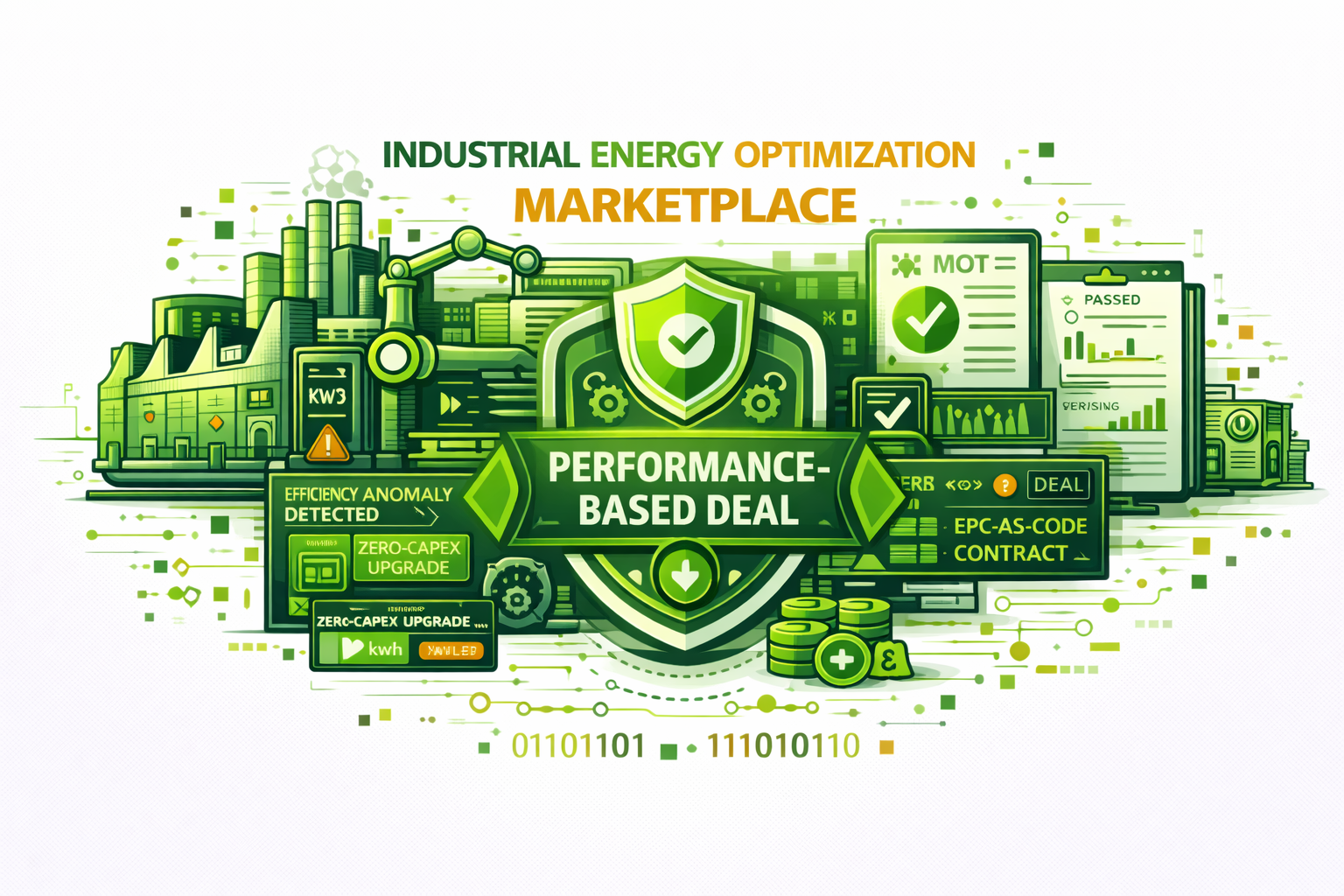
The UK's first Adversarial Efficiency MOT. We convert detected industrial energy anomalies into structured, fraud-proof Performance-Based Deals — enabling zero-capex upgrades for mid-sized factories through verified savings.

▸ Platform Validated Metrics
Failure Detection Accuracy 92%
Adversarial Tamper Rejection 95%
Diagnostic Window <15 min
Addressable UK Market £5B+
Assets Tested (TRL 7) 100+
92% Detection Accuracy
£5B+ Market Potential
15 min Diagnostic Window
TRL 7 Development Level

Closing the Execution
Gap in Decarbonization

The Industrial Energy-Optimization Marketplace (IEOM) is a data-driven, two-sided platform that converts detected industrial efficiency anomalies into structured, executable Performance-Based Deals. We address the "execution gap" in industrial decarbonization by embedding Energy Performance Contracting (EPC) logic and automated Measurement & Verification directly into software workflows.

We target the "missing middle" mid-sized factories in pharmaceutical, food & beverage, and manufacturing sectors enabling them to deploy energy-saving measures with zero upfront capital by paying providers through verified savings.

Unlike traditional Energy Management Systems that only provide dashboards, IEOM functions as a "Transaction Engine" processing high-frequency energy data to trigger automated project listings, backed by PRAM Act 2025 compliance.

EPC-as-Code Engine
Adversarial MOT
Asset Biometrics
PRAM Act 2025 Ready
Zero Capex Deals
Actuarial-Grade Output
Founder & CEO

Dhruv Bhatt brings over 7 years of specialized industrial experience in electrical engineering, renewable energy systems, and high-power utility maintenance.

Holding an MSc in Electrical Engineering and Renewable Energy Systems from Staffordshire University (2024), his expertise in smart power grids and advanced digital signal processing is the primary driver behind the platform's "Technical Truth Layer."

Dhruv personally manages development using MATLAB-Simulink, AutoCAD Electrical, and Multisim architecting proprietary simulation models for failure and waste prediction.

LinkedIn Profile ↗

From Anomaly to Verified Deal
in Under 15 Minutes

IEOM replaces slow, expensive manual audits with a four-stage automated pipeline converting raw energy data into financeable, fraud-proof performance contracts.

Diagnostics
STEP 01

High-Frequency Diagnostics

Our 100 kHz pulse-response engine performs non-invasive electrical fingerprinting of your industrial assets — chillers, compressors, VFDs generating a unique biometric ID for each machine in under 15 minutes.

Analysis
STEP 02

Adversarial Trust Engine

The platform detects baseline manipulation, BMS resets, meter tampering, and savings fraud generating a machine-verified "Confidence Score" that banks and insurers can rely on with actuarial certainty.

Marketplace
STEP 03

Automated Deal Origination

Detected efficiency anomalies are automatically converted into machine-generated "deal objects" structured EPC-as-Code contracts that providers can bid on within our controlled ecosystem.

Verification
STEP 04

Verified Savings & Compliance

Automated Measurement & Verification tracks delivered savings in real time. Digital Energy Passports are issued, fully aligned with SECR, ESOS, and the PRAM Act 2025 regulatory framework.

Six Pillars of the
IEOM Platform

A comprehensive industrial intelligence stack — from raw data ingestion to machine-readable compliance certificates. Each component is purpose-built for the high-stress environments of UK manufacturing.

Biometric fingerprinting
A

Electrical Biometric Fingerprinting

Creates an indelible electrical ID for every critical asset using 100 kHz pulse-response analysis. Prevents identity fraud even if physical nameplates or digital logs are tampered with.

Lifetime tracking persists across asset moves, resales, and remanufacturing cycles. The biometric ID is generated from the machine's intrinsic electrical characteristics impossible to clone or spoof.
EPC as code
B

EPC-as-Code Transaction Engine

Converts detected inefficiencies into structured deal objects with automated M&V. Baseline freezes, weather adjustment factors (HDD/CDD), and production normalization are fully automated.

Eliminates the legal overhead that traditionally kills mid-market EPC projects. Contract states are compiled directly into software, enforced by machine-readable logic rather than manual auditor oversight.
Adversarial engine
C

Adversarial Trust Computation

Detects fraud, baseline manipulation, BMS resets, and metadata "gaming" — the adversarial behaviors that undermine shared-savings contracts and investor confidence.

95% success rate in rejecting tampered performance claims during TRL 7 adversarial robustness testing. Collaboratively validated with industrial specialists simulating "bad actor" scenarios across pharma and manufacturing environments.
Risk maps
D

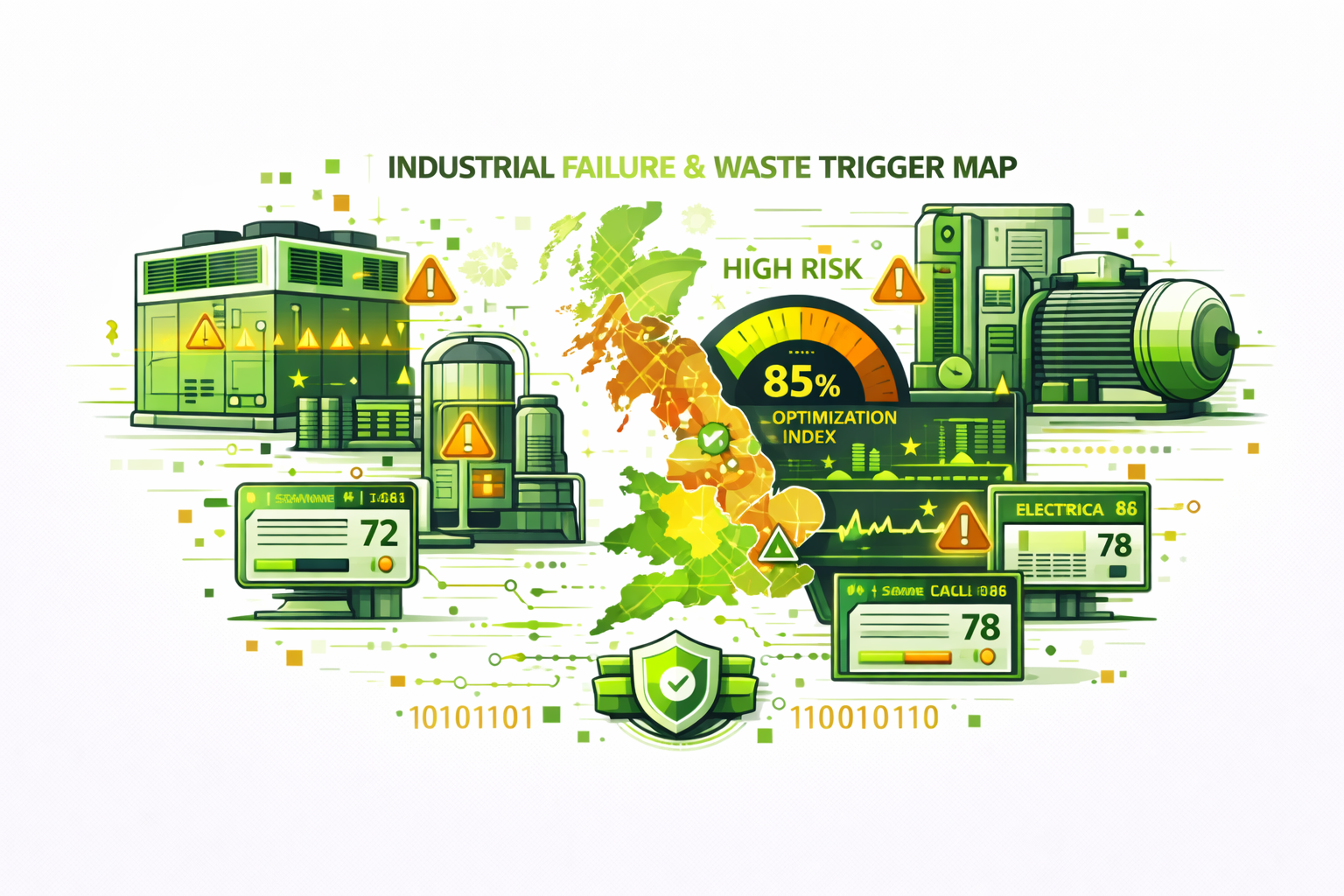
Industrial Failure & Waste Trigger Map

A sector-specific risk model scoring mechanical integrity, thermal stability, and electrical harmonics — calibrated for UK pharmaceutical and heavy manufacturing environments.

Identifies latent internal shorts, harmonic distortion, and motor-winding degradation primary precursors to catastrophic failure and energy waste. Achieves 85% Optimization Index accuracy in predicting asset-level structural failure.
Digital twin
E

Factory Digital Twin Ledger

Builds an "Energy-Asset Ledger" that maps site lines to specific meters, creating a finance-ready representation of industrial efficiency easier to underwrite, bundle, and securitize.

Provides the audit trail for green lenders and insurers to model performance risk accurately. Machine-readable operating envelopes ("Permitted Use Envelopes") define optimal setpoints based on current asset degradation state.
Compliance
F

PRAM Act 2025 Compliance Hub

A centralized registry providing high-assurance audit trails for "Energy Passports" fully aligned with SECR, ESOS, and the Product Safety and Metrology Act 2025.

Issues standardized "Negative Certificates" for failing equipment with coded failure modes and decommissioning protocols. Ensures hazardous assets are tracked and replaced rather than recirculated through unregulated second-hand markets.

Built for Every Scale
of Industrial Operation

From single-site diagnostics to national multi-hub deployments. Revenue from success fees, SaaS tiers, and API licensing aligned with the value we deliver.

Starter

Site Diagnostic

£2,500
per site assessment
  • 15-minute non-invasive scan
  • Up to 10 assets fingerprinted
  • Efficiency Confidence Score report
  • Basic failure risk map
  • PRAM Act compliance summary
Get Started →
Enterprise

National Hub License

Custom
multi-site + API licensing
  • Multi-site cluster deployment
  • Portable MOT Kiosk hardware
  • Insurance & lender API feeds
  • White-label certification portal
  • Regulatory & OPSS liaison
  • Dedicated forensic support
Enquire Now →

Common Questions

What is an Adversarial Efficiency MOT and how does it differ from a standard energy audit?

+
A standard energy audit relies on self-reported data and manual inspections — typically taking weeks and costing thousands. Our Adversarial Efficiency MOT uses 100 kHz pulse-response diagnostics to measure the intrinsic electrical characteristics of an asset, independent of any reported data. This means we detect tampered baselines, forged performance logs, and internal failure precursors that standard audits completely miss. The "adversarial" element means we treat every asset as potentially compromised the only approach that provides the high-assurance verification required by insurers and green lenders.

How does the zero-capex model work for factory operators?

+
Under our EPC-as-Code model, factories pay for energy-saving upgrades (VFDs, HVAC tuning, harmonic filters) entirely through the verified savings those upgrades generate. The IEOM platform automates Measurement & Verification independently confirming that savings are real before triggering payment. This eliminates the financial risk for the factory. Baseline freezes, weather normalization factors, and production-aware adjustments are all handled automatically by our contract engine, removing the legal overhead that typically makes these deals uneconomic for mid-market factories.

What industries and asset types does the platform support?

+
IEOM is purpose-built for mid-sized UK industrial facilities, with specific calibration for pharmaceutical manufacturing, food & beverage processing, and general manufacturing. Supported asset types include industrial chillers, compressors, Variable Frequency Drives (VFDs), Air Handling Units (AHUs), high-pressure boilers, UPS systems, and electrical panel infrastructure. The platform operates effectively in high-vibration, high-load environments the conditions that invalidate many commercial building-focused EMS tools. Minimum site energy spend of £200k/year is recommended for full Micro EPC deployment.

How does IEOM comply with the PRAM Act 2025?

+
The Product Regulation and Metrology Act 2025 mandates enforceable safety rules for energy assets and requires third-party performance certification infrastructure. IEOM was architecturally designed to be this infrastructure. Our Compliance Hub provides the "Technical Truth Layer" required by the Act generating tamper-evident Energy Passports with immutable audit trails, metrological grade diagnostics aligned with OPSS standards, and the "Negative Certificate" mechanism for non-compliant assets. We are actively engaged with the Office for Product Safety and Standards on upcoming regulatory guidance.

What is the current development status and what validation has been completed?

+
IEOM is at TRL 7 System Prototype Demonstration in Operational Environment. The prototype has been validated on over 100 degraded industrial utility assets, achieving 92% accuracy in detecting hidden failure modes and baseline resets, 95% adversarial tamper rejection, and sub-15-minute diagnostic throughput. All five core architectural elements are integrated and functional. We are progressing toward TRL 8 with portable MOT Kiosk hardware development underway, API ecosystem integration in progress, and provisional patent filings for the proprietary fingerprinting algorithms and Adversarial Trust Score.

How does the platform integrate with existing factory infrastructure?

+
The platform is designed as a software overlay that integrates with existing SCADA, BMS, and IoT infrastructure without requiring specialized hardware installation in most cases. Open APIs allow "plug-and-play" deployment across national energy hubs, insurance portals, and smart grid controllers. For full Micro-EPC functionality, our portable diagnostic hub can be deployed onsite. The edge inference architecture allows the system to operate in facilities with limited cloud connectivity, with local processing handling the most compute intensive diagnostics.


Request a Pilot or
Partnership Discussion

Whether you are a mid-sized manufacturer, pharmaceutical facility, ESCO, green lender, industrial insurer, or technology partner we would like to hear from you. Contact us to arrange a demonstration, discuss pilot opportunities, or explore licensing and partnership options.

Email dhruvbhatt864@gmail.com
Phone +44 7767 493479
Location United Kingdom
Target Sectors Pharma · Food & Bev · Manufacturing · ESCOs · Insurers · Green Finance